Pilates Reformer Room Requirements: Height and Clearance
Pilates reformer room requirements go past the footprint: plan for standing height, end clearance, floor type and a folded storage spot before you buy.
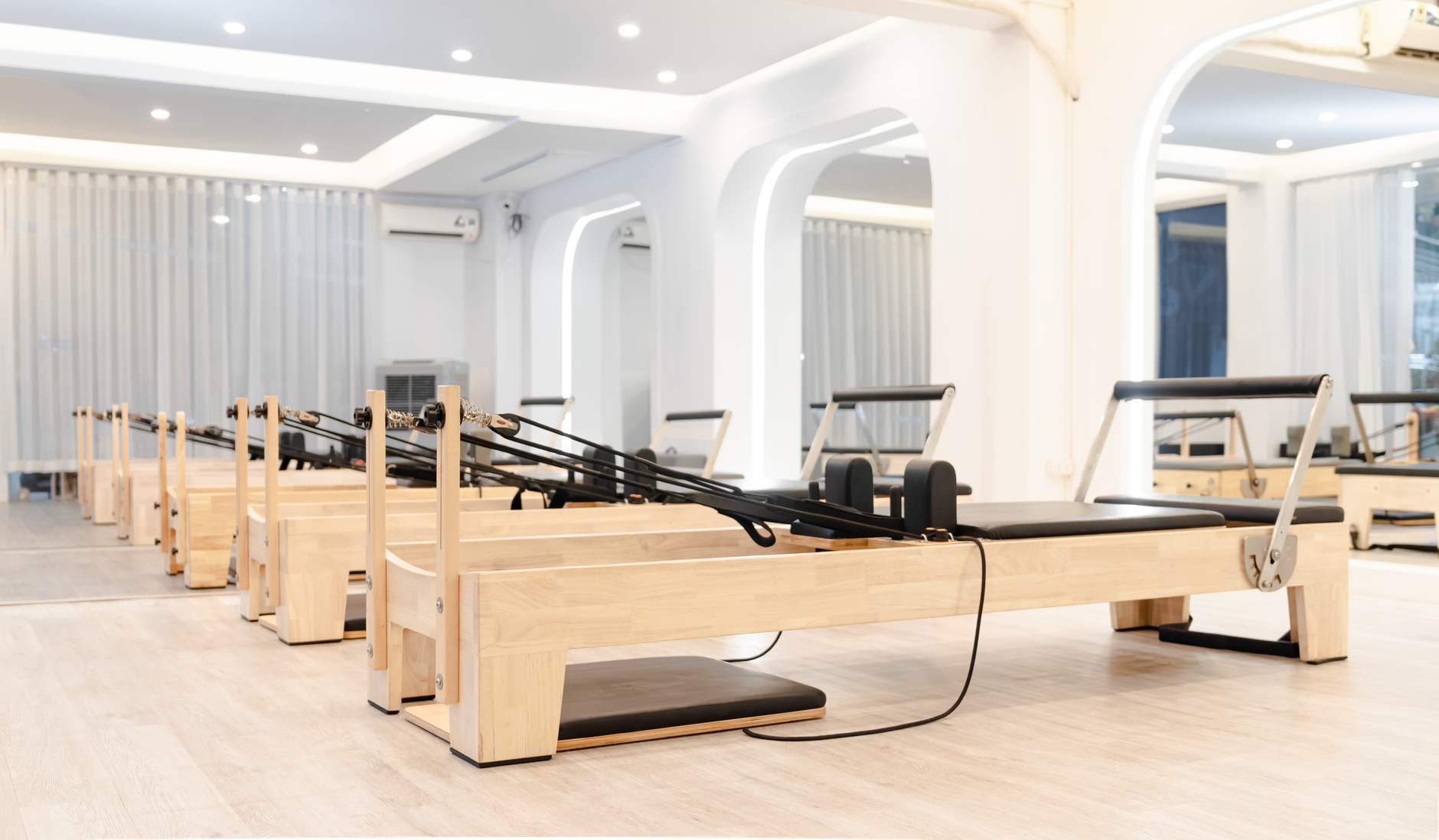
Photo by Lê Đức on Pexels
The tape measure comes out, the floor gets marked, the reformer arrives — and then someone stands on the footbar, reaches up, and taps the ceiling fan. The real pilates reformer room requirements are vertical as much as horizontal, and the ceiling is where most home setups get caught out. Here is the short version: allow roughly 3 feet of clear space at the head end and 2 feet at the foot end, keep 24 inches of walking room on at least one long side, and make sure the ceiling is high enough that a tall person standing on the carriage still has a hand's width of air above their fingertips.
For most reformers, the carriage sits 12 to 16 inches off the floor. Add a 6-foot person standing on it with arms overhead and you are asking for something close to 9 feet of ceiling. A standard 8-foot ceiling still works for the vast majority of home practice — you simply skip or modify the standing overhead work — but you want to know that going in, not while you are balancing on a moving carriage. Below is the whole measurement, floor by floor and inch by inch.
How much space does a Pilates reformer actually need?
Start with the machine itself. Full-size home reformers generally run 8 to 8.5 feet long and 22 to 27 inches wide. Foldable models fold to something closer to 3 to 4 feet long and stand upright or slide under a bed. Those numbers are on the product page — check them before anything else, because a 6-inch difference in length decides whether your reformer fits along a wall or has to sit diagonally in the room.
Then add the clearance, which is the part people forget:
- Head end (shoulder rests/headrest): 2.5 to 3 feet. This is where the ropes and straps live, where you sit up and swing your legs off, and where a spotter or instructor stands. It is also where you reach back for the loops.
- Foot end (footbar): 1.5 to 2 feet. Enough to load and unload springs without kneeling in a doorway, and enough to walk around the end if the room allows.
- One long side: at least 24 inches. You need a working side for getting on and off, and for standing exercises beside the machine.
- Other long side: 12 inches minimum. The frame can sit near a wall, but not against it — you want a hand in there to move it and to keep the rails free of dust and baseboard.
Do the arithmetic and a full-size reformer wants a clear zone of roughly 12 to 13 feet long by 5 feet wide. That is a spare bedroom, a wide hallway landing, half a garage, or a decent chunk of a living room. If your room is short, orienting the machine so the head end points into open floor rather than at a wall buys you the clearance where it matters most.
Doorways, radiators and the things at ankle height
Measure the route in, not just the destination. An 8-foot boxed reformer will not turn a tight stair landing, and some models ship in one long carton by freight rather than parcel. Check the shipping notes on the listing. Once it is in the room, watch for radiators along the working side (heat plus a straining spring is an unpleasant combination), floor vents under the carriage, and skirting-board power sockets that the frame will block.
What ceiling height do you need for a reformer at home?
Here is the formula worth writing on the back of your hand:
Carriage height + your height + about 8 inches of reach and safety margin = the ceiling you want.
A carriage 14 inches off the floor plus a 5-foot-8 practitioner is 6 feet 10 inches standing flat. Arms overhead adds roughly 14 to 16 inches for most people. You land around 8 feet 2 inches — which means a standard 8-foot ceiling is a near miss for overhead standing work, and comfortable for absolutely everything else.
What actually needs the height:
- Standing on the carriage — side splits, standing lunges, and any overhead reach from the carriage.
- Elephant and up-stretch variations — less about height, more about not clipping a light fitting with your hips as you shift back.
- Tower or half-trapeze attachments, if your reformer takes one. These add a vertical frame that typically needs 7.5 to 8 feet of clear height on its own, plus wall anchoring on some models. If a tower is in your future, measure for it now.
- Jumpboard work — you are lying down, so ceiling is not the issue, but the machine needs its full length plus board depth, which can add 8 to 12 inches at the foot end.
Basements are the usual pinch point. A finished basement with 7-foot ceilings and a run of ductwork down the middle can still be a fine reformer room — you just place the machine so the low soffit runs along the foot end, not over the carriage. Sloped attic ceilings work on the same principle: put the tall side over your head end.
Lights, fans and the ceiling you forgot to look at
Ceiling height is measured to the lowest thing hanging from it, not to the plaster. A pendant light, a ceiling fan, a smoke alarm, a sprinkler head — any of these can steal a foot. Before you commit to a spot, stand where the carriage will sit, raise both arms, and look up. Swapping a pendant for a flush-mount fixture is a cheap fix that often unlocks a room.
Which floors work under a reformer, and which cause problems?
Reformers are heavy — typically 80 to 130 pounds for a home model — but the load is spread across four or six feet, so structural weight is rarely the issue. Surface behavior is.
Hardwood and engineered wood: excellent. Stable, level, quiet. Use felt pads or a mat under the feet to prevent scuffing when you shift the machine, and check that the boards do not flex under load in an older house.
Tile and concrete: very stable, and the most forgiving of an unlevel-looking frame — but hard and cold. A 6mm to 10mm dense mat under the machine takes the edge off the noise and keeps the feet from creeping.
Carpet: workable but needs thought. Thick pile with a soft underlay lets the frame rock slightly as the carriage travels, which you feel as a wobble at the end of a stroke. A rigid board or a firm exercise mat under the feet fixes almost all of it. Low-pile commercial-style carpet is fine as is.
Basements and garages: check level and check damp. Concrete slabs often slope toward a drain, and a reformer sitting on a slope makes the carriage want to drift one way. Shims under the feet solve small slopes. Humidity is the other one — springs, upholstery and any wood in the frame do not enjoy a damp room.
Noise and the neighbors below
The sound of a reformer is the carriage returning and the springs releasing — a low rolling thump. On a ground floor with a slab, nobody hears it. On a first floor above a bedroom or in an apartment, a dense rubber mat under the frame makes a genuine difference, and so does easing the carriage back rather than letting the springs snap it home.
Foldable or full-size: which suits your room?
This is really a storage question dressed up as a machine question. Ask yourself whether the reformer can live set up. If the answer is yes — spare room, garage bay, dedicated corner — a full-size frame gives you a longer carriage track, a sturdier feel and easier access to accessories.
If the reformer has to share space with a sofa, a guest bed or a car, folding matters more than anything else on the spec sheet. Look for three things on the product page: folded dimensions (not just "compact"), whether it stands upright unassisted or needs to lean, and whether it has wheels or a transport handle. A 100-pound machine that folds but has to be dragged will end up permanently unfolded.
Field notes from the flock: measure your storage slot before you measure your workout slot. A gap beside a wardrobe or the space behind a door is usually the constraint, and it is easier to find a machine that fits the gap than a gap that fits the machine.
If you are comparing formats, the foldable and full-size home reformers at PersonalHour list folded and assembled dimensions together, which makes the "will this live in my hallway cupboard" question answerable in about thirty seconds. Their machines ship with accessories and app-based coaching, which is worth factoring in if you are choosing between buying a machine and keeping a studio membership.
A quick pre-purchase measuring checklist
- Ceiling height, measured to the lowest fixture in the room — not to the plaster.
- Your height plus carriage height plus 8 inches; compare to line 1.
- Room length: machine length + 3 feet at the head + 2 feet at the foot.
- Room width: machine width + 24 inches on the working side + 12 inches on the other.
- Delivery route: doorways, stair turns, and whether the carton comes by freight.
- Floor: level, firm, and dry. Shim, mat or dehumidify as needed.
- Folded storage slot, if the machine will not live set up.
- Power and light: you want a socket for a fan or speaker, and light that is not directly in your eyes when you are lying down.
Get those eight lines settled and the machine choice becomes straightforward rather than a gamble. When you are ready to browse, the studio-grade reformers built for home rooms are a sensible place to start comparing dimensions side by side — no rush, and the tape measure is the part that does the real work.
Common questions
Can you use a Pilates reformer with an 8 foot ceiling?
Yes, for the large majority of reformer work. An 8-foot ceiling comfortably covers lying, seated, kneeling and quadruped exercises. What it limits is standing on the carriage with arms overhead, since the carriage sits 12 to 16 inches up. Taller practitioners may need to modify those few exercises. Check the lowest ceiling fixture, not the plaster height.
How much clearance do you need around a Pilates reformer?
Plan for about 3 feet at the head end where the ropes and straps are used, 2 feet at the footbar end for loading springs, at least 24 inches on your working side for getting on and off, and 12 inches on the opposite side so the frame is not flat against a wall. That totals roughly 12 to 13 feet by 5 feet for a full-size machine.
Can you put a Pilates reformer on carpet?
You can, though thick pile with soft underlay allows the frame to rock slightly as the carriage travels. Placing a rigid board or firm exercise mat under the machine's feet stabilizes it and stops the feet sinking. Low-pile carpet usually needs nothing extra. On any floor, check the machine sits level before your first session.