Home Pilates Reformer Buying Guide: Size, Springs, Storage
A home Pilates reformer buying guide covering foldable vs full-size frames, real footprint and storage, carriage travel, spring systems and app coaching.
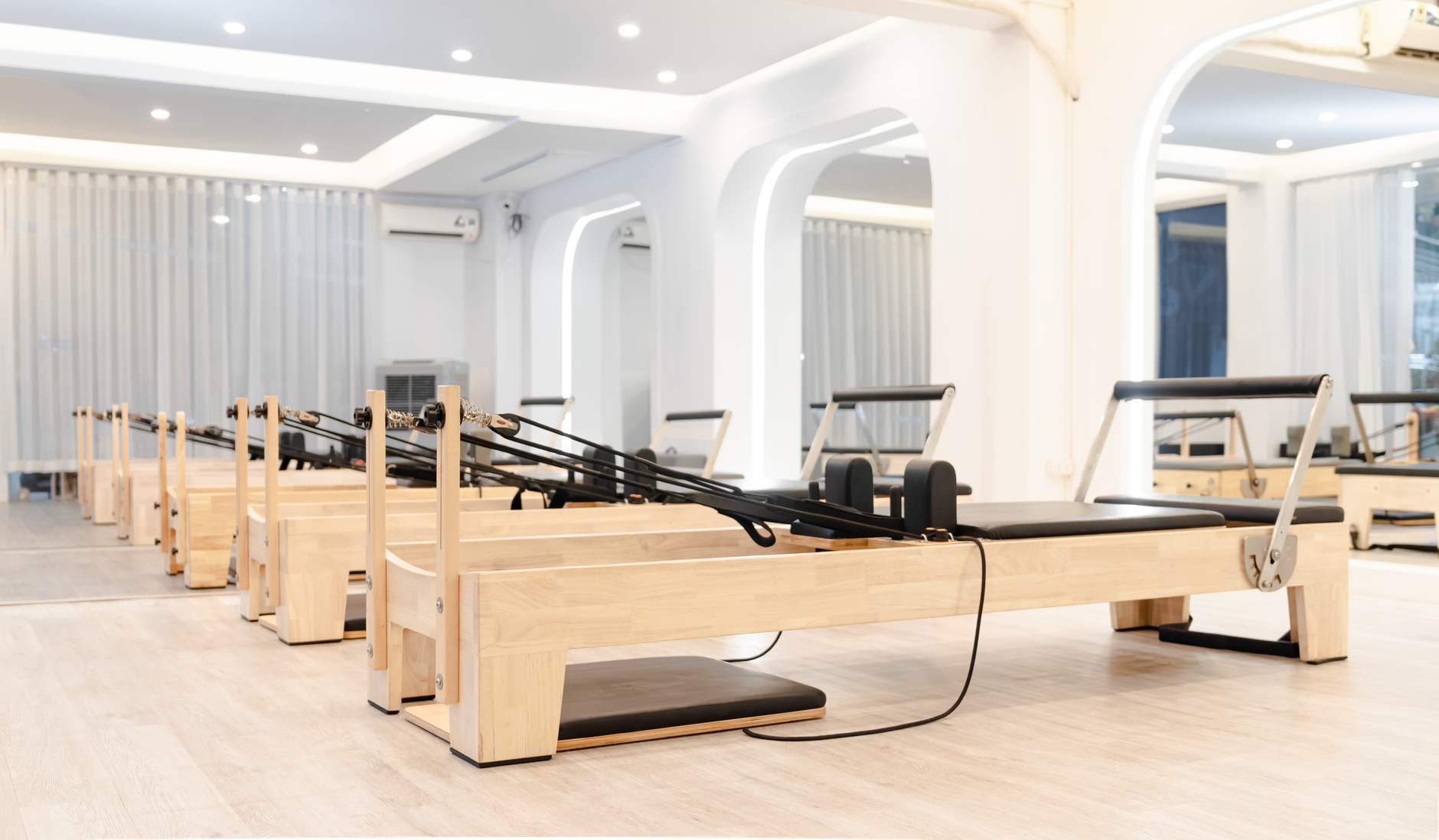
Photo by Lê Đức on Pexels
The tape measure is the most honest piece of Pilates equipment you own. Before you compare spring colors or watch a single studio demo, walk to the room where the machine will actually live, measure the floor, and then add three feet at the footbar end for your own arms and legs. That one number decides more than anything else in this home Pilates reformer buying guide, because a reformer that technically fits the room but not the movement is a very expensive laundry rack.
The short answer: most full-size home reformers run roughly 8 to 9 feet long and 22 to 27 inches wide, and you want at least two feet of clear space at each end plus room to stand alongside. Foldable reformers shrink storage depth, not length — they typically fold in half or lift on end, so plan for a 4 to 5 foot parked footprint against a wall. Springs matter more than frame material: look for at least four springs with genuinely different tensions, and check whether the machine lists carriage travel, because a short carriage cuts your leg press and long-stretch range before your body ever does.
How much space does a home Pilates reformer actually need?
Manufacturers publish frame dimensions. Your body needs clearance. Those are different measurements and the gap between them is where most buyer regret lives.
Work through it in this order:
- Frame length. Full-size reformers usually land between 96 and 108 inches. Compact and foldable models often trim to 80 to 92 inches by shortening the rail or the footbar overhang.
- Footbar clearance. Standing lunges, elephant and knee stretches all push you past the front of the frame. Two feet minimum, three if you're tall.
- Headrest clearance. Long box work, overhead arm springs and any prone series need room behind the shoulder rests. Eighteen inches is workable; two feet is comfortable.
- Side clearance. You will step off, kneel beside the carriage and reach for straps. Eighteen to twenty-four inches on at least one side.
- Ceiling height. Rarely an issue lying down, but standing on the footbar or doing overhead work on a raised platform eats headroom fast.
Add it up and a full-size reformer wants a clear rectangle around 13 feet by 6 feet during use. That's a spare bedroom, a garage bay, or a living room where the coffee table moves. If your honest number is smaller, that's not a dealbreaker — it's just a strong argument for a shorter frame or a folding one.
The storage reality nobody puts on the spec sheet
"Foldable" covers at least three different mechanisms, and they store very differently.
Hinge-fold in the middle. The frame breaks in half and the two halves come together. Storage depth drops to roughly half the length, but the folded shape is bulky and often heavy in an awkward place. Great for sliding under a bed frame with clearance, less great for a closet.
Tilt-and-store vertical. The whole reformer stands on end against a wall. Footprint becomes tiny — maybe 2 by 3 feet of floor — but you need eight-plus feet of vertical clearance and a wall you can lean a heavy object against safely. Check whether the model includes a wheel set or stabilizing feet for this.
Wheeled roll-away. Not folding at all, just casters. Honest and simple: the machine stays full length but slides to a wall in ten seconds. If your room is long but multi-purpose, this often beats folding, because folding is the step people stop doing by week three.
Be ruthless with yourself here. A machine you have to unfold, re-square and re-tension before a twenty-minute session gets used less than one that's already open. If you have the floor, a full-size frame that rolls is usually the more sustainable choice. If the room genuinely doubles as something else, folding earns its complexity.
Foldable vs full-size reformer: which one suits your room?
Frame construction is where the two categories separate beyond the hinge. Full-size wood or heavy-gauge aluminum frames tend to feel more planted, with less lateral flex when you push hard through the footbar. Folding frames add joints, and joints are where movement and noise can creep in over time — which is why the hinge hardware is worth a close look on the product page.
Things to check before you commit either way:
- Stated user weight capacity, and whether it differs folded versus open.
- Rail material and wheel count. Four wheels on aluminum rails is common; more wheels usually means a quieter, smoother glide.
- Carriage travel distance. If it isn't listed, ask. This is the usable stroke, and short travel quietly limits long stretch, running and full leg press extension.
- Shoulder rest adjustability and headrest positions — a fixed flat headrest is fine for some bodies and uncomfortable for others.
- Footbar positions. Three or four height settings is a meaningful difference from one fixed bar.
- Rope and riser system. Adjustable ropes matter enormously if more than one person of different height will use it.
If you want to see how one catalogue handles both ends of that spectrum, a range of foldable and full-size home reformers with accessories is a useful reference point for comparing frame length, carriage specs and what comes in the box before you shop wider.
Height, weight and who else uses it
Taller users feel a short carriage immediately. If you're over about 5'10", prioritize stated carriage travel and rail length over folding convenience — you can always roll a machine to the wall, but you cannot add stroke. If two people of very different heights will share it, adjustable ropes and a multi-position footbar move from nice-to-have to essential, because otherwise one of you spends every session slightly cramped.
What do reformer spring systems tell you about resistance?
Spring color coding is not standardized across brands. A red spring on one machine is not the same tension as a red spring on another, so ignore color comparisons between manufacturers entirely and read the actual descriptions.
What does transfer across brands:
- Number of springs. Four is a workable minimum, five is common on studio-style machines. More springs means finer increments, not just more load.
- Tension spread. You want genuinely light options as well as heavy ones. Light springs are harder work in a lot of arm and core repertoire, not easier — the carriage is less supported.
- Attachment mechanism. Clip-on hooks are fast and quiet. Some designs use a gear bar with fixed loops. Either works; what matters is whether you can change tension quickly without getting off the carriage mid-flow.
- Replaceability. Springs are consumables. Confirm the maker sells replacements individually and note the expected service interval.
- Noise. Metal-on-metal ping is normal, but a machine with rubber-sleeved hooks or coated springs is noticeably kinder in an apartment.
One thing worth internalising: springs on a reformer aren't like weights on a rack. They provide assistance as often as resistance, depending on the exercise and your position on the carriage. That's why a class instruction like "go lighter" can mean the movement is about to get considerably harder. It's also why a machine with only two or three tension steps limits your progression sooner than you'd expect.
Is included app coaching enough to start without a studio?
Honestly? For a lot of people, yes — with a caveat worth taking seriously.
App coaching bundled with a reformer solves the biggest beginner problem, which is not knowing what to do once the box is unpacked. A structured library gives you spring settings, footbar heights and a session order, and that removes the paralysis that leaves machines unused. If a reformer includes app-based programming, treat it as a real part of the value, and check the practical details: is it included indefinitely or a trial period, how many classes are in the library, are there genuine beginner foundations rather than just workouts, and does it run on the device you'd actually prop up beside the carriage?
The caveat is feedback. An app can't see that your shoulders are creeping or that your pelvis shifts on the return. If you're new to Pilates, a handful of in-person or live-video sessions early on — even three or four — will make every home session afterwards more productive. That isn't a safety warning, it's just how motor learning tends to go. Many people do the reverse: months of app work, then one studio session that reframes everything.
A quick checklist for evaluating the coaching side:
- Are class lengths varied? Ten- and fifteen-minute options get used on busy days.
- Does each class state spring settings for the specific machine you're buying?
- Is there a progression path, or just a shuffled library?
- Can you filter by focus — back, hips, postnatal, mobility?
- Does it work offline, if your machine lives in a basement or garage with weak signal?
What accessories are worth buying with the machine?
A few genuinely extend what the reformer can do; the rest can wait.
The short box and long box are the biggest repertoire unlock — box work covers a huge slice of classical exercises and neither is easy to improvise. A jumpboard is the other high-value add, turning the reformer into low-impact cardio work. A padded platform extender helps with standing work if your model doesn't have one built in. Sitting boxes, straps and handles usually ship with the machine; confirm rather than assume.
Things you can skip at first: extra spring sets before you've worn the originals out, branded mats, and anything described as a "bundle" without an itemised list. Field notes from the flock: the accessory people most regret not buying at the outset is the box, and the one most often bought too early is the jumpboard.
Common questions
How much space do you need for a home Pilates reformer?
Plan for the frame length plus about two feet of clearance at each end and eighteen to twenty-four inches along one side. For a typical 8 to 9 foot full-size reformer, that's roughly a 13 by 6 foot working area. Foldable models reduce the parked footprint to around 4 to 5 feet deep, or 2 by 3 feet if they store upright against a wall.
Is a foldable reformer as sturdy as a full-size one?
Good foldable reformers are stable and well-engineered, but they add hinge joints that a solid frame doesn't have. Check the stated user weight capacity, the locking mechanism on the hinge and the rail material. If your room can accommodate a full-length frame on casters, that's often the simpler long-term choice, since rolling it aside takes seconds and nothing needs re-squaring.
How many springs should a home Pilates reformer have?
Four springs is a practical minimum and five is common on studio-style machines. What matters more than the count is the spread of tensions, since light springs make many exercises harder rather than easier by reducing carriage support. Spring colors are not standardized between brands, so read the tension descriptions rather than comparing colors across manufacturers.
If you're ready to compare frame lengths, carriage travel and spring counts side by side, it's worth browsing studio-style reformers built for home rooms with your room measurements already written down. Take the tape measure first, the spec sheet second — the rest gets much easier after that.