Pilates Reformer Accessories: What You Will Actually Use
Which Pilates reformer accessories earn their place at home, which ones gather dust, and what to check on the product page before you add anything to the cart.
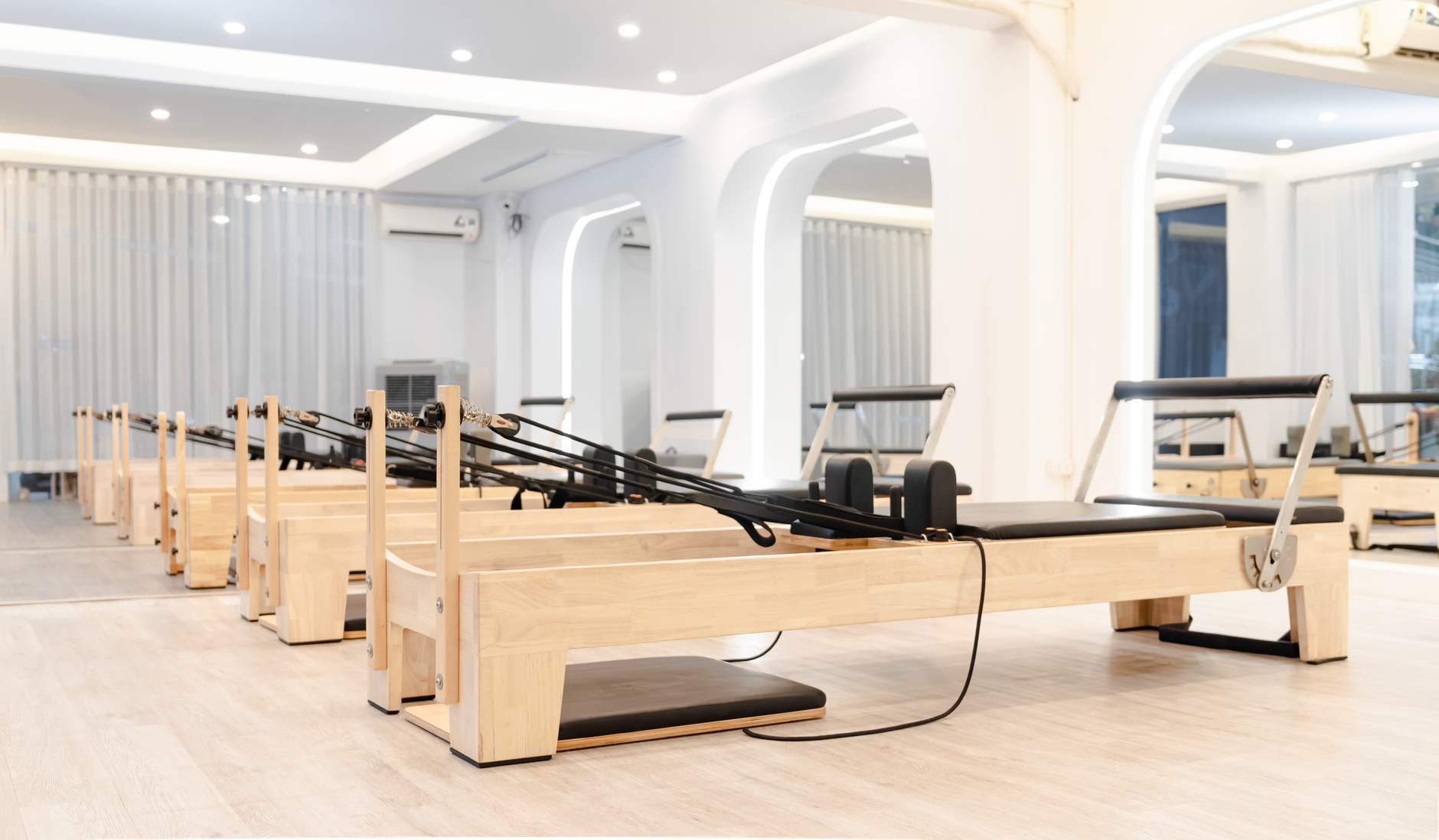
Photo by Lê Đức on Pexels
There is a very particular kind of clutter that collects beside a home reformer. A jump board leaning against the wall. A box you used twice. Two loops still in their plastic bag. None of it was a bad idea at the time — it just turned out that most Pilates reformer accessories solve problems you do not have yet, while a handful quietly change what you can do on the machine from week one.
The short answer: the accessories you will actually use are the ones that either make the carriage fit your body (a proper box, a sitting or standing platform, decent straps and loops) or let you keep training when your regular springs feel wrong (an extra light spring, a stability cushion). The ones that gather dust are usually the big single-purpose add-ons — jump boards, tower extensions, ped-o-pulls — bought before there was a routine to hang them on. Buy the fit items first, live with the machine for two months, then decide whether the exciting stuff is still exciting.
Below, a sorting of the whole category: what each accessory does, who it is genuinely for, and what to look for on the product page so you do not end up with something that will not fit your carriage.
Which Pilates reformer accessories are worth buying first?
Start with the pieces that appear in almost every beginner and intermediate class sequence. If an accessory shows up in the first ten workouts of any program, it is not an extra — it is part of the machine.
The long box (and the short box, if they are separate)
If you buy one thing, buy the box. It sits on the carriage and instantly opens up a whole second category of work: short box series for the abdominals and back, long box for pulling straps, swan, and the prone leg work that is hard to replicate anywhere else. Without a box you are limited to supine and standing repertoire, which gets repetitive fast.
What to check before you buy: the box must sit securely on your carriage rails without sliding — some are shaped to nest against the shoulder rests, others rely on friction alone. Look for a stated weight capacity, a vinyl or PU cover you can wipe down, and whether a footstrap is included (you need one for the short box series, and buying it separately later is annoying). If your reformer folds for storage, check the box's dimensions against wherever you plan to slide it.
Straps, loops and handles
Most reformers ship with something. Whether it is something you want to hold for forty minutes is another question. Nylon loops with thin webbing dig into the arch of the foot; double loops with padded edges do not. Wooden or molded handles are more comfortable for arm work than a soft loop, and being able to swap between the two mid-session without re-threading anything is a genuine quality-of-life upgrade.
Look for: adjustable rope length with clear markings or a cleat you can move one-handed, padded loop edges, and stitching that is bar-tacked rather than a single straight seam. If your ropes are rope-and-cleat rather than fixed webbing, a spare set of ropes is cheap insurance — they are the part that wears.
An extra light spring
Not glamorous. Very useful. Light springs are what you need for arm work, for anything overhead, and for the days your body is not interested in your usual load. Many home machines come with a sensible spread but only one truly light spring; a second one gives you finer control over the middle of your range. Check the manufacturer's color coding and connector type before ordering — springs are not universal, and a hook that does not match your gearbar is a paperweight.
What does a beginner actually need on day one?
Honestly, less than the accessory bundle photos suggest. A beginner needs a machine that fits their leg length, a box, comfortable loops, and something to follow. That last one is the piece people underspend on.
This is where buying a reformer that comes with coaching built in earns its keep. PersonalHour's foldable and full-size home reformers ship with accessories and app-based classes included, which means the sequencing decision is made for you for the first few months — you are following a program rather than improvising, and you find out which accessories your program actually calls for before you buy more of them. That is a much better way to build an accessory shelf than guessing.
A rough day-one kit, in order of how often you will reach for it:
- Long/short box with footstrap — used in most intermediate sequences.
- Padded double loops or handles — comfort determines whether you finish the session.
- One extra light spring — for arms, overhead work and lighter days.
- A non-slip mat under the frame — stops carriage momentum walking the machine across a hard floor.
- A small stability cushion or folded towel — head and neck support on the carriage, and worth having before you buy a purpose-made headrest pad.
That is it. Everything else can wait until a class asks for it.
Which reformer add-ons usually gather dust?
Not because they are bad products — most are well made and studios use them daily. They gather dust at home because they need either a specific repertoire, a specific space, or a level of confidence most people take a year to reach.
The jump board
Wonderful in a class with an instructor calling rhythm. At home, it is a large flat panel that needs storing, and jumping supine on springs is one of the harder things to self-coach safely. If your ceiling is low, if your floor is shared with a downstairs neighbor, or if your program does not include cardio-Pilates, this one sits behind the door. Buy it after you have done jumpboard classes elsewhere and missed them.
Tower, half-trapeze and push-through bar
These convert a reformer into something closer to a Cadillac, and they are genuinely brilliant if you know the tower repertoire. The catch is that they are heavy, they usually require a compatible frame and a wall or foot-end mount, and folding reformers frequently cannot take them at all. Check your frame's compatibility list first — not the general product description, the specific model list. If it is not named, assume no.
Ped-o-pull, sitting box lid extras, arc barrels
Studio-standard, home-optional. An arc barrel is the most likely of the three to earn a spot, because spinal extension over a barrel feels good and takes little skill. The others are repertoire-specific. If you cannot name three exercises you want to do with it, you will not do three exercises with it.
Weighted balls, magic circles and light dumbbells
These are the sneaky ones. Individually cheap, so they accumulate. In practice you will keep one magic circle and one pair of light weights, and the rest will migrate to the cupboard. Buy them one at a time, as a class calls for them.
How do you check an accessory will fit your reformer?
Fit is where most returns come from, and it is entirely avoidable with five minutes of measuring. Before you order anything, write these numbers down and keep them in your phone:
- Carriage width, rail to rail — determines whether a box or platform sits properly.
- Rail spacing and rail profile — some boxes nest into the rails, some sit on top.
- Shoulder rest height and spacing — a box that clears them is a different shape from one that butts against them.
- Spring connector type (hook, clip, or loop) and the manufacturer's color code.
- Rope diameter, if you are replacing ropes or loops.
- Frame footprint and folded footprint, for anything that mounts to the frame.
Then look for the phrase "compatible with" on the product page and see whether your model is named. Universal-fit claims are usually true for mats and cushions, sometimes true for boxes, and rarely true for springs, towers or footbar attachments. If a listing shows only styled photos and no dimensions, treat that as missing information rather than a detail you can sort out later.
Where does an accessory budget go furthest?
Two places. The first is anything that touches your body for the whole session — loops, handles, headrest padding, the box cover. Discomfort is the main reason home machines go quiet, and it is cheap to fix.
The second is coaching. A well-structured program will get more out of a bare reformer than a shelf of attachments will out of an unstructured one. If you are still choosing a machine, it is worth comparing what is bundled: reformers that include accessories and guided classes tend to remove three separate purchasing decisions at once, which is often the difference between a machine that gets used and a very expensive clothes rail.
One small field note from watching this category: the accessories people re-buy are almost always consumables — ropes, springs, loop pads, box covers. The accessories people resell are almost always the large ones. That pattern tells you where to be generous and where to be patient.
Common questions
Do I need a Pilates reformer box for home workouts?
A box is the single most useful reformer accessory for home use because it unlocks the short box and long box series — abdominal, back extension and prone leg work you cannot do on the flat carriage. Check that it sits securely on your rails, has a stated weight capacity and includes a footstrap, since the short box series needs one.
Are Pilates reformer springs interchangeable between brands?
Generally no. Spring tension, length and connector type vary between manufacturers, and color coding is not standardized across brands. Always order springs from your reformer's maker or from a listing that names your exact model as compatible. If you are unsure, photograph the hook where the spring meets the gearbar and compare it against the product page images.
Is a jump board worth it for a home reformer?
For most home users it is a later purchase, not a first one. Jump boards suit cardio-focused Pilates sequencing and take up meaningful storage space, so they work best if you already follow jumpboard classes and know you enjoy them. If your ceiling is low or you live above neighbors, consider whether the format fits your space before buying.