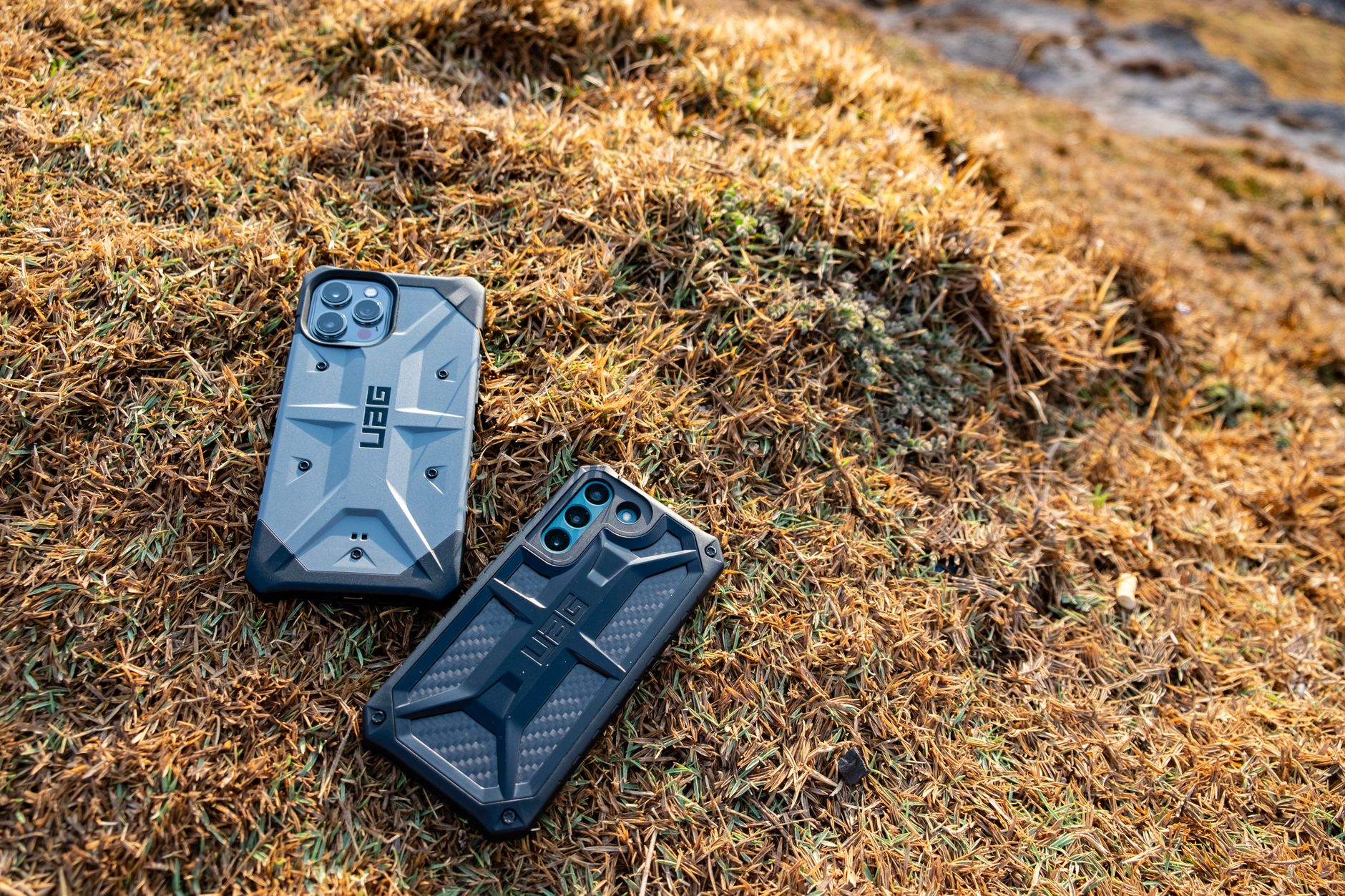
How to Tell if a Phone Case Actually Protects Your Phone
Drop ratings, corner airbags, lip height, port covers: how to read a phone case product page and judge real protection instead of trusting the word "rugged."
Photo by Ethan Tran on Pexels
The word "rugged" costs a seller nothing. It's not certified, it's not measured, and it can sit just as comfortably on a case built from two millimeters of shock-absorbing polymer as on a thin shell with a camouflage pattern printed on the back. Which is why the moment you start shopping for protection, you're really shopping for evidence — and evidence lives further down the product page than most of us bother to scroll.
The good news: a protective case gives itself away. There are five or six details that show up in the photos, the spec table and the customer questions, and once you know what they look like, you can size up a listing in about ninety seconds. Here's what to look for.
Drop ratings: what "military grade" does and doesn't mean
Almost every rugged case cites MIL-STD-810, usually shortened to "military grade drop tested." It sounds like a certification body somewhere signed off. It isn't quite that.
MIL-STD-810 is a US Department of Defense document describing environmental test methods — a menu of procedures covering shock, vibration, humidity, temperature and more. The drop procedure most case makers reference involves dropping a device onto plywood over concrete from a set height, across multiple faces, edges and corners. There's no central authority that inspects the results. A manufacturer can run the tests in-house and declare compliance.
That doesn't make the claim useless. It means you should read it as a description of what was tested rather than a seal of approval, and reward brands that get specific. A listing that says "tested to MIL-STD-810H, 26 drops from 1.2 m onto every face, edge and corner" is telling you something. A listing that says "military grade" and stops is telling you they know the phrase sells.
Numbers worth noticing
- Drop height. Higher is harder. Waist-height and head-height are very different tests. A stated height beats no height every time.
- Number of drops. A single successful drop is luck. Repeated drops across multiple orientations show the structure holds up.
- What it was dropped onto. Plywood over concrete is the standard surface. Bare concrete or steel is a tougher claim.
- What counted as a pass. The best listings say the device remained functional and the screen intact. Vaguer ones just say "passed."
You'll also see independent lab names cited on some pages — third-party testing is a genuinely better signal than self-declared numbers, because someone outside the company had to put their name on it.
Corners are where phones actually die
Drop a phone flat on its back and the whole rear panel shares the load. Drop it on a corner and all that energy funnels into one small point — which is exactly why corners crack screens, pop displays out of frames and bend chassis.
So the corners are the first thing to look at in the photos. What you want is visible extra material: a thicker, often ribbed or hollowed section at each of the four corners. Marketing calls these "airbags," "air cushions" or "shock-absorbing pockets," and the name is more literal than you'd think. A hollow chamber in flexible TPU compresses on impact and slows the deceleration, spreading the force over more milliseconds. A solid slab of plastic just transmits it.
Two things to check:
- Look for a cutaway or exploded-view image. Serious cases show the internal structure — the honeycomb pattern, the air pockets, the layered construction. If the brand built it, they usually want to show it.
- Check that the corner is meaningfully thicker than the sides. Uniform thickness all the way around is a styling choice, not a protection strategy.
Multi-layer construction matters here too. The common recipe is a soft TPU inner shell that absorbs and a harder polycarbonate outer shell that resists abrasion and stops the case deforming. Single-material cases can still be good — a thick, well-designed TPU case is far better than a thin hybrid — but if a listing advertises "dual layer," look for photos of the two pieces separated. Some "dual layer" cases are one piece with two colors.
Lip height: the millimeters that save your screen
Here's the detail that separates cases that work from cases that photograph well. The lip is the raised edge of the case that stands proud of the screen and the camera glass. When your phone lands face-down on a table, the lip touches first and the screen never does.
Most decent cases quote a screen lip somewhere around one to two millimeters and a camera lip that's often taller, because camera bumps already protrude. What you're looking for on the product page:
- A stated measurement, ideally for the screen and the camera separately.
- A side-on photo of the case lying face-down, showing daylight between the surface and the glass.
- A continuous lip — some designs interrupt the raised edge with gesture cutouts at the bottom or curve it away at the corners, which is precisely where you don't want it missing.
The trade-off is real: taller lips can catch on edge-swipe gestures and feel less pleasant under the thumb on curved-edge phones. A gently bevelled lip is a reasonable compromise. A flush one isn't a compromise, it's an omission.
One more thing on the camera: check whether the ring around the lenses is a raised rim or just a hole. A rim keeps the lens glass off gritty surfaces. A bare cutout leaves the most expensive part of your phone as the first point of contact.
Port covers, buttons and the unglamorous bits
Port covers are the flaps that plug the charging port and, on some designs, the speaker grilles. They're mainly about dust, sand and splashes rather than full waterproofing, and they matter a lot more if your phone lives on a job site or in a beach bag than if it lives on a desk.
Read the wording carefully. "Dust plug" and "port cover" are honest. Language that implies a case makes a phone waterproof deserves skepticism — a case with cutouts for speakers and buttons cannot seal a device, and any real waterproof rating belongs to a fully sealed enclosure with a stated IP number and a clear description of what's actually being rated.
Buttons are a quieter quality signal than people realize. Covered buttons — where the case molds over the volume and power keys — keep grit out and usually feel more deliberate. But a badly molded button cover is genuinely annoying to live with, so this is one spec where the customer questions and photos of the case in hand tell you more than the description does. Open cutouts are perfectly fine; they just do less.
A quick page-scanning checklist
- Is there a specific drop height and drop count, not just "military grade"?
- Do the corners have visible airbags or reinforced structure?
- Is a screen lip measurement stated, or at least visible in a side-on photo?
- Does the camera cutout have a raised rim?
- Are ports covered, and is the claim about dust rather than waterproofing?
- Is the exact phone model listed — not "fits iPhone 15 series," but your model?
- Does the listing say anything about wireless charging compatibility if you use it?
The trade-offs nobody puts in the headline
Protection is not free. Thicker cases add bulk and weight, make one-handed use harder and can interfere with slim wallets and car mounts. Heavy-duty cases with metal accents can affect wireless charging or magnetic accessory alignment — worth checking if you rely on either.
And a case is only half the equation. A raised lip protects the screen from flat surfaces; it does far less against a rock or a set of keys. Pairing a protective case with a tempered glass screen protector is the usual approach, and buying both from the same brand at least means the protector is cut to sit inside the case's lip rather than fighting it.
Finally, be honest about how you actually use your phone. Someone who cycles to work with a phone in a jersey pocket needs different things from someone whose phone travels between a desk and a coat. Buy for the drops you actually take.
Where to look next
If rugged protection is what you're after, FNTCASE is the store in our flock built for exactly this — military-grade cases for iPhone, Samsung, Pixel and Motorola, plus screen protectors and accessories, so a case and a matching protector can come from one place. Their listings are a good place to practice everything above: check the corners in the photos, find the lip, read the drop claim closely and see whether your exact model is spelled out.
Take your time with it. A phone case is one of those purchases where fifteen minutes of reading the spec table beats fifteen minutes of reading reviews, and the difference shows up the first time your phone slides off the passenger seat.