Dog Toy Rotation: Keep Toys Interesting Month to Month
A practical guide to dog toy rotation: how many toys to keep out, matching toy types to how your dog plays, and when a worn toy should be retired.
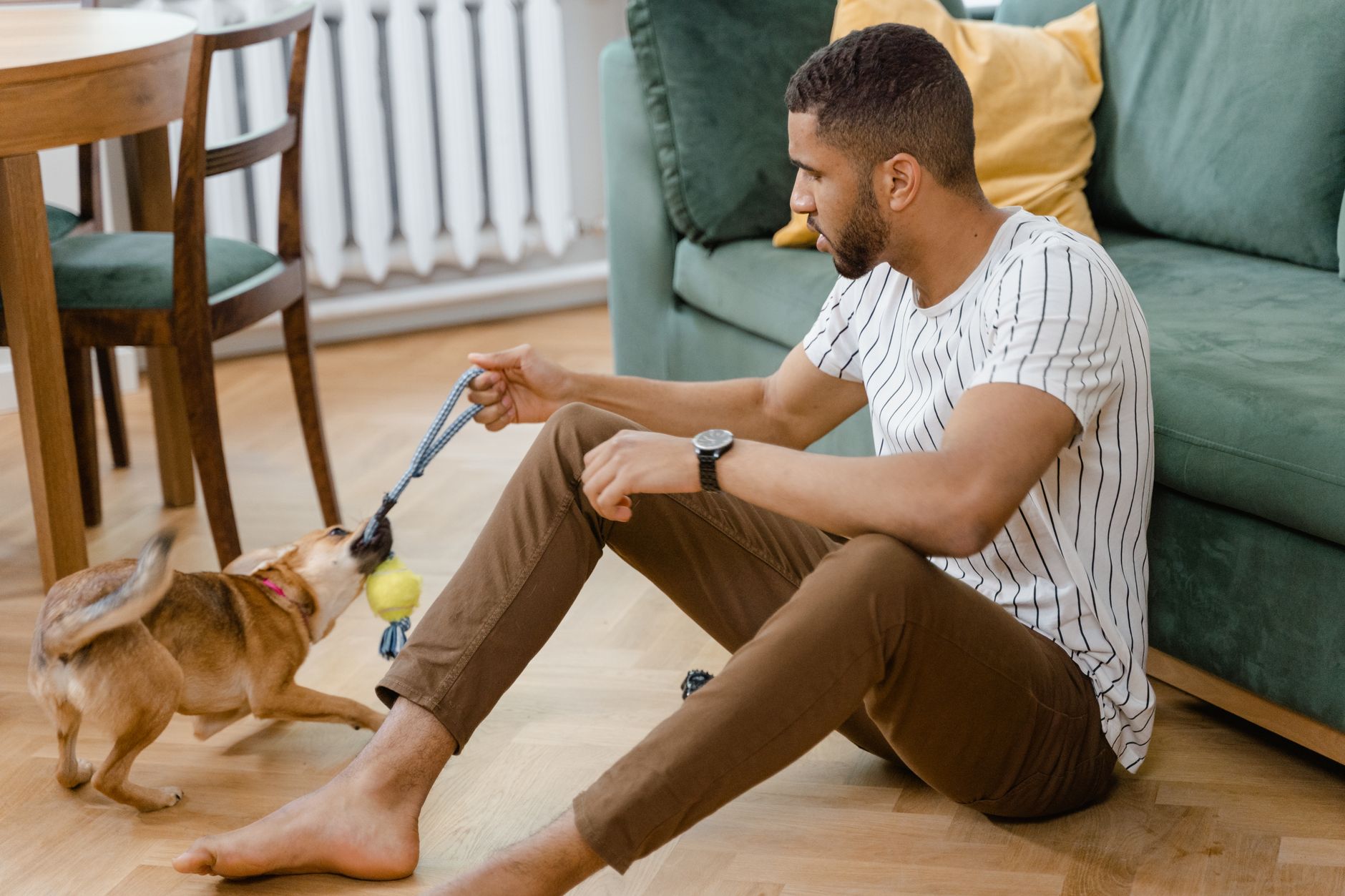
Photo by MART PRODUCTION on Pexels
Your dog has fourteen toys and plays with one. It's the ugly rope thing with the knot chewed loose, and the other thirteen sit in a basket getting stepped over. That's not a dog problem or a toy-buying problem — it's an availability problem, and dog toy rotation fixes most of it without you spending another dime.
The short version: keep three to five toys out at a time, store the rest somewhere your dog can't see or smell them, and swap the sets every one to two weeks. A toy that disappears for ten days comes back genuinely interesting, because the novelty resets. Pair that with matching toy types to how your dog actually plays — shredder, chewer, fetcher, puzzle-solver — and a small collection outperforms a big pile. The rest of this piece is the how, plus the part most owners skip: knowing when a beat-up toy has stopped being a toy.
How does dog toy rotation actually work?
Novelty is the whole engine. Dogs habituate fast — an object that's been in the same spot for three weeks stops registering as a thing worth investigating. Take it away, let the scent and the memory fade a little, and bring it back, and you get a chunk of that first-day enthusiasm again. It's the same reason a suitcase gets sniffed like it's brand new every single time.
Here's a rotation setup that holds up in a real house:
- Out at any time: three to five toys, covering at least two different play styles. Not five squeaky plushes.
- In storage: everything else, in a lidded bin or a closet shelf. Opaque matters — if your dog can see the bin contents through clear plastic, it's not really put away.
- Swap interval: every 7 to 14 days. Shorter for dogs who burn through interest quickly, longer for dogs who form attachments.
- The exception: one comfort toy stays out permanently. If your dog sleeps with a specific plush, it is not part of the rotation. Rotating that one is just taking something away.
- Timing the swap: do it while your dog is out on a walk or in another room. Toys appearing is more fun than toys being handed over.
Wash what goes into storage. A plush that's been carried around for two weeks goes in a mesh laundry bag on a gentle cycle; rubber and nylon get warm soapy water and a full dry before the lid goes on. A toy that comes out of the bin smelling like the last time it was used is less new to a nose than it is to your eyes.
Rotate by type, not just by object
The mistake that quietly kills a rotation is swapping five plushes for five other plushes. Your dog notices the sameness even if the shapes differ. A good active set has variety built in: something to chew, something to shake or shred, something that moves when thrown, and something that makes the dog think. Swap sets so each new lineup shifts the balance — a heavy-chew week, then a puzzle-forward week.
Which toy types match how your dog plays?
Watch your dog with a new toy for sixty seconds and you'll usually get an answer. Most dogs lean one way, with a secondary style underneath.
The shredder
Grabs a plush, finds the seam, and goes for the stuffing with real focus. Shredders aren't being destructive for its own sake — they're doing the take-it-apart sequence. Look for toys built with that in mind: layered or "unstuffable" designs, hidden squeakers inside pockets, crinkle inserts, plush shells that hold a separate replaceable insert. Supervise these, always. The goal is a toy that survives being worked on, not one that vanishes in ninety seconds.
The power chewer
Settles in, chews methodically, and leaves dents in things that shouldn't dent. Power chewers need firm rubber or nylon, and they need it sized correctly — a toy your dog can fit entirely behind the molars is too small. On a product page, look for a stated durability tier or a "for tough chewers" designation, plus a size chart tied to weight. A chew toy should flex slightly under pressure rather than shatter, and it should be too large to swallow whole even after it's worn down.
The fetcher
Brings it back, drops it, stares at you. Fetchers care about how a toy moves — bounce, roll, float, the way it flips unpredictably on a lawn. Rotate the motion, not just the color. A ball that bounces true and a lopsided one that skitters sideways are two different games to a retrieving dog. Check that fetch toys are made of a single durable piece where possible; balls with thin outer coatings can peel once they've been gummed enough times.
The thinker
Sniffs a new toy carefully, works angles, gets bored with plain fetch. Thinkers do well with treat-dispensing toys, snuffle mats, and anything with a hidden compartment. These earn their keep in a rotation because the puzzle stays fresh longer than a static object does — you can change what's inside. A thinker toy that's also the treat vehicle can turn ten minutes into a genuinely tiring activity.
The tugger
Wants you involved. Ropes, braided fleece, rubber rings with handles. Tug toys are best kept as interactive-only items you bring out and put away, rather than free-access toys — partly because that's what preserves their value, and partly because ropes need supervision. Loose strands get swallowed.
Where does a monthly box fit into a rotation?
Rotation only works if there's something to rotate into. The classic failure mode is a bin of eight toys your dog has already exhausted — nothing in it is new anymore, no matter how long it sits in the closet. You need a slow trickle of genuinely fresh items so the rotation stays a rotation instead of a reshuffle.
That's the honest case for a subscription. BarkBox sends two new toys and two bags of treats each month on a themed lineup, which maps neatly onto a two-week swap cycle: this month's pair goes into the active set, and two older toys go into storage to cool off. Because the toys arrive on someone else's schedule and someone else's theme, you also end up with shapes and textures you wouldn't have picked yourself — which is exactly what a rotation wants. Left to our own devices, most of us buy the same three things over and over.
A few things worth checking before you sign up for any dog box, this one included:
- Size and chew-strength options. Boxes are usually built around dog size, and some offer a heavier-duty track for dogs who go through plush quickly. Pick honestly — a power chewer in the standard tier will just make confetti.
- Allergy and ingredient handling. If your dog avoids chicken or grain, look for how the service handles that on the sign-up flow before you commit.
- The actual terms. Plan lengths, billing timing, shipping, how skipping or ending a plan works, and whether there's any replacement policy for a toy that doesn't survive — read the current terms on the BarkBox site rather than trusting a summary anywhere else, including ours. Subscription details change and only the merchant's own page is authoritative.
- Whether you'll use the treats. Two bags a month is real food volume. If your dog is on a measured feeding routine, factor the treats into the plan.
One field note from the flock: don't put both new toys out on arrival day. Open the box, let your dog investigate both, then quietly retire one to the bin for a couple of weeks. You've just doubled the number of new-toy days you get out of the same box.
When should you retire a worn dog toy?
This is the part rotation makes easier, because every swap is a built-in inspection. Handle each toy as it goes into the bin and give it ten seconds of attention.
Retire a toy when you see any of these:
- An open seam on a plush that exposes stuffing or a loose squeaker. You can sew a small split closed once; a second failure in the same spot means it's done.
- Chunks missing from rubber or nylon. Surface scuffing is normal wear. A piece bitten out is not — that's material going somewhere.
- Cracks or sharp edges in hard plastic or rubber, especially on ball-style toys that have started to split.
- A rope that's unraveling into loose strands, or one that's gone stiff and stringy at the ends.
- Size drift. A chew toy worn down small enough to fit fully in your dog's mouth has changed category. Size it up.
- Detached parts: eyes, tags, bells, rope handles pulled free of the body.
Toys that get pulled apart on purpose — layered plush, insert-based designs — can look alarming and still be fine, as long as the pieces are large and nothing hard has come loose. The question isn't "does it look destroyed." It's "is there a piece here small enough to be swallowed, or an edge sharp enough to matter." When you're unsure, retire it. A toy is replaceable.
Keep a small mesh bag in the toy bin for retirees so a compromised toy doesn't drift back into circulation. And when something gets retired, that's your cue to pull a rested toy out of storage rather than to buy a replacement immediately — half the time the rotation covers it.
How do you keep the rotation from falling apart?
Rotations die from admin, not from disinterest. Three things keep them alive:
Attach the swap to something you already do. Trash night, Sunday laundry, the day the box shows up — anything with an existing rhythm beats a reminder you'll snooze.
Keep the storage bin somewhere convenient for you. A bin in the basement means the rotation stops in about three weeks. A bin in the hall closet survives.
And keep the collection small enough to track. Ten to fifteen toys total is plenty for most dogs. Beyond that you're not rotating, you're inventorying, and nothing gets enough time away to feel new again.
If your bin is looking tired and every toy in it has been thoroughly conquered, a monthly delivery of new toys and treats is a low-effort way to keep fresh material entering the cycle. Have a look, check the sizing tiers and the current terms, and see whether the rhythm suits your dog.
Common questions
How often should you rotate dog toys?
Every 7 to 14 days works for most dogs. Shorter intervals suit dogs who lose interest quickly; longer ones suit dogs who form attachments to specific objects. Keep three to five toys out and store the rest out of sight. Leave one comfort toy permanently available — rotating a dog's security item away tends to backfire.
How many toys should a dog have out at once?
Three to five is a good target, chosen to cover at least two play styles rather than five versions of the same thing. A typical set might be one chew, one plush, one fetch item and one treat-dispensing puzzle. Total collection size of ten to fifteen toys gives you enough to rotate without anything sitting so long you forget it exists.
When should you throw away a dog toy?
Retire a toy when a plush seam has opened and exposed stuffing or a squeaker, when chunks are missing from rubber or nylon, when hard plastic has cracked into sharp edges, when a rope is shedding loose strands, or when a chew toy has worn down small enough to fit entirely in your dog's mouth. If you're unsure, retire it.